Solar Panel Mounting Structures for Industry in Jakarta
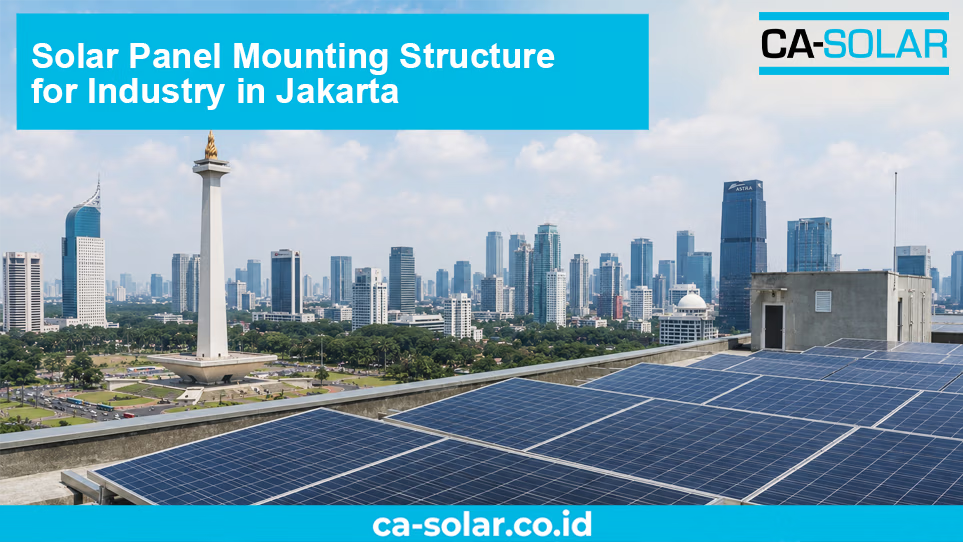
Understanding Solar Panel Mounting Structures for Industrial Use
A solar panel mounting structure for industrial applications is a support system designed to hold solar panels in large-scale installations, such as factories, warehouses, and industrial facilities.
Unlike small-scale systems, industrial mounting structures must handle higher loads, provide long-term durability, and support efficient installation processes.
The Role of Mounting Structures in Industrial Solar Projects
In industrial projects, the mounting structure plays a critical role, including:
- Supporting a large number of solar panels securely
- Maintaining optimal panel positioning and tilt
- Withstanding environmental and wind loads
- Improving installation efficiency in large-scale projects
- Enabling future system expansion
Choosing the right structure is essential to ensure the success of industrial solar installations.
Characteristics of Industrial Environments in Jakarta
- High-Density Industrial Areas : Jakarta’s industrial zones are densely populated, often limiting available installation space.
- Limited Installation Space : Many industrial facilities rely on rooftops due to limited open land.
- Weather and Pollution Conditions : Exposure to heat, rain, and pollution can impact the durability of mounting materials.
- Structural Load Considerations : Industrial buildings vary in structure, requiring mounting systems that can adapt without overloading the building.
Challenges of Solar Mounting Structures in Jakarta
- Limited Installation Area : Restricted space requires efficient and compact structural designs.
- Installation Access and Process : Active industrial environments often limit access and installation time.
- Corrosion and Environmental Exposure : Humidity and pollution can accelerate material degradation.
- Adaptation to Existing Structures : Each facility has unique structural conditions, requiring flexible solutions.
- Time Efficiency Requirements Industrial projects demand fast and efficient installation processes.
Solutions in Designing Solar Mounting Structures for Industry
- Location-Adaptive Design : Structures must be designed to suit specific site conditions.
- Proper Material Selection : Durable and corrosion-resistant materials are essential.
- Use of Modular Systems : Modular systems allow faster and more flexible installation.
- Structural and Load Optimization : Designs must ensure proper load distribution without stressing the building.
- Installation Efficiency : Easy-to-assemble systems reduce on-site work and project time.
The Role of Aluminium in Industrial Environments
Aluminium is widely used in modern solar mounting systems due to its advantages:
- High corrosion resistance
- Lightweight compared to steel
- Easy to install
- Ideal for modular systems
In Jakarta’s industrial environment, aluminium provides durability and efficiency benefits.
Modular Systems as a Solution for Industrial Projects
Modular mounting systems are increasingly adopted in industrial solar projects due to their flexibility and efficiency. Key advantages include:
- Faster installation
- Standardized components
- Easy adaptation to different conditions
- Scalability for future expansion
This approach is highly suitable for industrial projects requiring speed and flexibility.
Key Factors in Choosing Solar Mounting Structures for Industry
- Site Conditions : Environmental factors influence material and design choices.
- Type of Industrial Building : Building structure determines the mounting approach.
- Project Scale : Larger projects require more efficient systems.
- System Flexibility : Flexible systems allow easier adjustments and expansion.
- Ease of Installation : Simpler installation reduces time and costs.
Case Illustration in Jakarta’s Industrial Sector
In many industrial projects in Jakarta, aluminium modular mounting systems are used to overcome space limitations and speed up installation.
These systems allow faster deployment without disrupting operations and enable future expansion without major structural modifications.
Conclusion
Solar panel mounting structures play a crucial role in ensuring the success of industrial solar installations, especially in Jakarta where space, environmental conditions, and efficiency are key challenges.
By selecting the right design, materials, and modular systems, these challenges can be effectively addressed.
This approach not only improves installation efficiency but also provides long-term flexibility for industrial energy development.