Why Electricity Prices Are Rising and What is the Solution
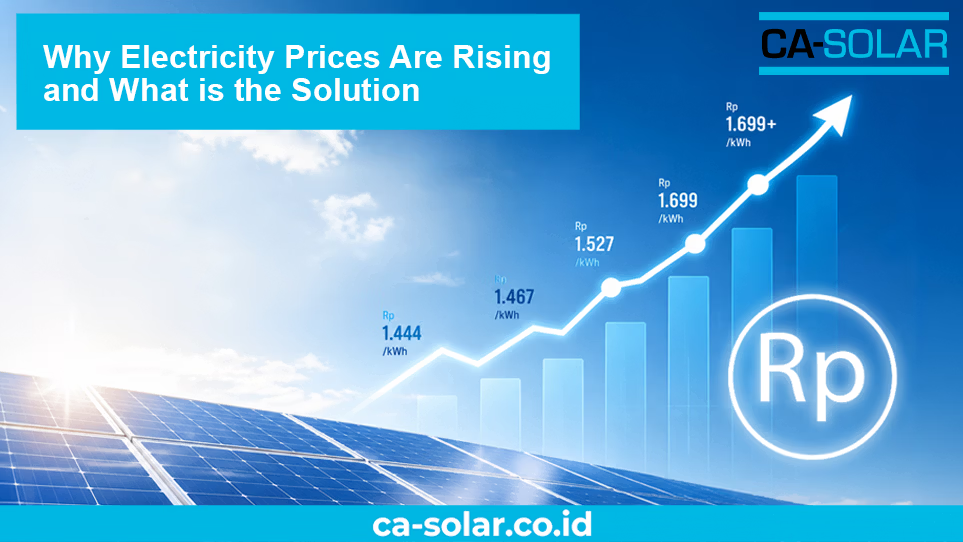
Electricity is one of the primary needs in modern life. Households require electricity for various daily activities, while industries use it to run production machinery, cooling systems, lighting, conveyors, pumps, and various other supporting facilities.
This dependence on electricity means that changes in energy costs can directly impact expenses. When electricity prices increase, households may face higher bills, whereas for industries, rising electricity costs can affect operational and production expenses.
However, why do electricity prices go up?
Electricity prices are not determined by a single factor alone. Power generation costs, fuel prices, grid conditions, electricity demand, government policies, and energy market conditions can all influence electricity costs.
Amid growing energy needs, understanding these factors becomes crucial so companies can formulate better energy strategies.
One approach increasingly being considered is utilizing renewable energy sources, such as solar energy.
What Causes Electricity Prices to Rise?
Electricity prices are the result of various components within the energy system. A change in any single component can influence the electricity cost borne by consumers. Several factors that can affect electricity prices include:
- Power generation fuel prices.
- Changes in electricity demand.
- Power plant operational costs.
- Grid maintenance and expansion costs.
- Energy supply conditions.
- Policies and regulations.
- Global energy market conditions.
Because these factors are interconnected, electricity price increases can occur when the costs to generate and distribute energy rise. This becomes even more relevant during global energy crises, as disruptions in energy supply can affect the prices of various energy commodities and ultimately put pressure on energy costs.
The Impact of Fuel Prices on Electricity Costs
Some power plants still rely on fuels such as coal, natural gas, or other energy sources. When fuel prices fluctuate, the cost of generating electricity can also be affected.
Global energy price changes can be influenced by various conditions, including supply and demand dynamics, production disruptions, geopolitical situations, and supply chain bottlenecks. This is one reason why an energy system overly reliant on specific sources can face risks when global conditions shift.
Diversifying energy sources is one way to build a more flexible and resilient energy system.
Increasing Electricity Demand
In addition to generation costs, growing electricity demand presents another challenge for the power system. Industrial growth, building construction, digitalization, electric vehicles, data centers, and the widespread use of electronic devices drive continuous growth in electricity demand.
When electricity demand rises, the power system requires adequate generation capacity and grid infrastructure to meet those needs. In the long run, demand growth makes energy efficiency increasingly vital for both households and industries.
For companies, eliminating unnecessary electricity usage can serve as an initial step toward controlling operational costs.
Why Do Rising Electricity Prices Have a Major Impact on Industry?
Industries have significantly higher energy demands compared to many other sectors. In manufacturing processes, electricity is utilized across nearly all operational areas. Production machines, conveyors, compressors, HVAC systems, pumps, lighting, and various other equipment often run for extended hours.
When electricity costs rise, the impact can be seen across several areas:
- Operational costs increase.
- Production costs become higher.
- Profit margins may decline.
- Budget planning becomes more challenging.
- Company competitiveness can be affected.
Therefore, companies need to view energy not merely as an expense to be paid, but as an integral part of their operational strategy. Energy efficiency can help reduce unnecessary consumption, while adopting alternative energy sources can help companies decrease reliance on a single electricity provider.
Is Reducing Electricity Consumption Enough?
Reducing electricity consumption is an important step, but it may not be the sole solution. Companies can implement various efforts, such as using more efficient equipment, optimizing operating hours, improving HVAC efficiency, utilizing energy-efficient lighting, and monitoring electricity usage.
However, if a facility’s energy baseline remains high, the enterprise still needs to secure large volumes of energy. For this reason, alongside improving energy efficiency, companies can also consider diversifying their energy sources—one approach being the implementation of solar panels.
Solar Panels as an Alternative Energy Source
Solar panels harness sunlight to generate electricity using photovoltaic (PV) technology. Simply put, sunlight absorbed by the panels is converted into DC electricity, which an inverter then converts into AC electricity suitable for powering various equipment.
Matahari -> Panel Surya -> Listrik DC -> Inverter -> Listrik AC -> Beban
Unlike conventional generation that requires fuel to produce electricity, solar panels utilize a naturally available energy source. This makes solar energy a viable renewable option to support the diversification of energy systems.
Understanding what solar energy is and how it functions is crucial for companies looking to explore its working mechanisms and potential benefits.
How Solar Panels Help Reduce Electricity Costs
Solar panels can help supply a portion of electricity needs directly from solar energy. In systems designed to support industrial demands, the electricity generated by the panels can power specific loads whenever energy is available.
Consequently, a portion of the electricity previously drawn from the grid can be supplemented by self-generated power. Potential savings depend on several factors, such as:
- Solar panel system capacity.
- Total electricity consumption.
- Electricity usage patterns.
- Industrial operating hours.
- Installation site conditions.
- Solar energy potential.
- Investment and installation costs.
Because of these variables, companies must plan based on actual requirements rather than simply installing as many panels as possible. Discussions on how solar panels reduce industrial operational costs serve as a valuable reference for understanding how solar energy fits into enterprise cost-management strategies.
Why Are Industrial Facilities Well-Suited for Solar Energy?
One key characteristic of industrial facilities is high energy demand during operational hours. For facilities with high daytime activity, energy generated by solar panels during these peak hours can directly help meet power demands.
Factory and warehouse roofs also present attractive installation locations for solar PV systems, as they offer vast surface areas without requiring additional land acquisition.
However, not all rooftops are identical. Available area, orientation, tilt angle, structural condition, and environmental surroundings must be carefully evaluated prior to finalizing an installation design.
More Than Just Panels: Mounting Systems Matter
When discussing solar power, attention often focuses solely on panels and inverters. However, the supporting framework plays an equally critical role. A solar mounting system is used to secure the panels and maintain their position throughout their operational lifespan.
These systems must be engineered to match specific installation types and withstand environmental forces such as wind, rain, humidity, and temperature fluctuations. Selecting proper components in a modern solar array ensures that all system parts function cohesively as a unified structure.
In modular setups, components like Solar Profiles, Mid Clamps, End Clamps, Foot Brackets, and Join Bars are integrated to build custom mounting structures tailored to site requirements.
How to Protect Your Solar Panel Investment
Lowering electricity costs depends on more than just initial panel installation; the system must also be maintained to perform optimally over the long term. Dust, dirt, debris, moisture, and environmental conditions can impact panel performance and structural integrity over time.
Routine inspections help identify issues early and preserve overall system health. Therefore, structural maintenance guides form an essential part of post-installation system management
In addition to maintenance, material selection should align with local environmental conditions, as different locations expose structures to varying stress factors.
Can Solar Panels Eliminate Electricity Bills Entirely?
Solar panels do not automatically mean a enterprise can completely eliminate electricity bills. The volume of electricity generated depends on system capacity, weather patterns, geographic location, installation design, and consumption characteristics.
Furthermore, industrial facilities still require grid power when solar generation falls short of immediate demand. Thus, the objective of solar panel adoption is best understood as reducing grid reliance and optimizing energy costs, rather than totally replacing grid electricity.
Companies should perform detailed needs assessments to determine the most suitable system configuration.
Long-Term Solutions: Energy Efficiency and Diversification
Addressing rising electricity costs requires a holistic approach. Companies can combine multiple strategies, ranging from upgrading equipment efficiency and reducing wasted power to energy monitoring and adopting renewable energy sources.
Solar panels serve as a key component of this multi-faceted strategy. By blending energy efficiency with renewable energy, businesses can build energy management systems that focus on immediate cost reductions while planning for long-term energy sustainability.
This strategy aligns with green manufacturing principles, particularly for industries seeking to enhance operational efficiency while lowering their environmental footprint.
CA-Solar: Supporting Industrial Solar Mounting Needs
Leveraging solar energy effectively requires systems tailored to specific facility demands. Beyond sizing panel capacity, companies must account for mounting structures to ensure panels are installed securely and safely based on site conditions.
CA-Solar provides modular solar mounting systems complete with components such as Solar Profiles, Mid Clamps, End Clamps, Foot Brackets, and Join Bars. Modular designs allow mounting configurations to be adapted to specific project needs and installation environments.
With proper engineering, solar mounting systems ensure long-term security, flexibility, and durability for solar installations.
Conclusion
Rising electricity prices stem from diverse factors, including fuel costs, energy supply dynamics, demand growth, generation expenses, and power grid constraints.
For industrial operations, shifts in energy pricing can have a substantial impact, as electricity is fundamental to almost every operational process.
Reducing electricity usage through energy efficiency measures provides a practical starting point. However, businesses should also explore energy diversification through renewable sources.
Solar panels offer a reliable option to cover a portion of electricity demands using sunlight. The extent of actual savings ultimately depends on system capacity, usage patterns, site conditions, and proper installation planning.
By combining energy efficiency, solar power utilization, and reliable mounting systems, industries can build more efficient, long-term energy strategies.
Ultimately, solving rising electricity costs is not just about finding cheaper power sources—it is about consuming energy more intelligently, diversifying supply sources, and establishing a sustainable energy framework.