Understanding Different Types of Renewable Energy and Their Examples
Energy demand continues to increase along with population growth, industrial development, and the increasingly widespread use of technology in everyday life. Electricity is needed for almost every activity, from household needs to the operations of factories, warehouses, commercial facilities, and various other infrastructures. This condition makes the availability of energy sources an important part of supporting economic activities and development.
For many years, energy needs have largely been met through fossil fuels such as coal, petroleum, and natural gas. These energy sources play a major role in modern energy systems, but their quantities are limited and their formation requires a very long period of time. Their use is also associated with greenhouse gas emissions and various environmental challenges.
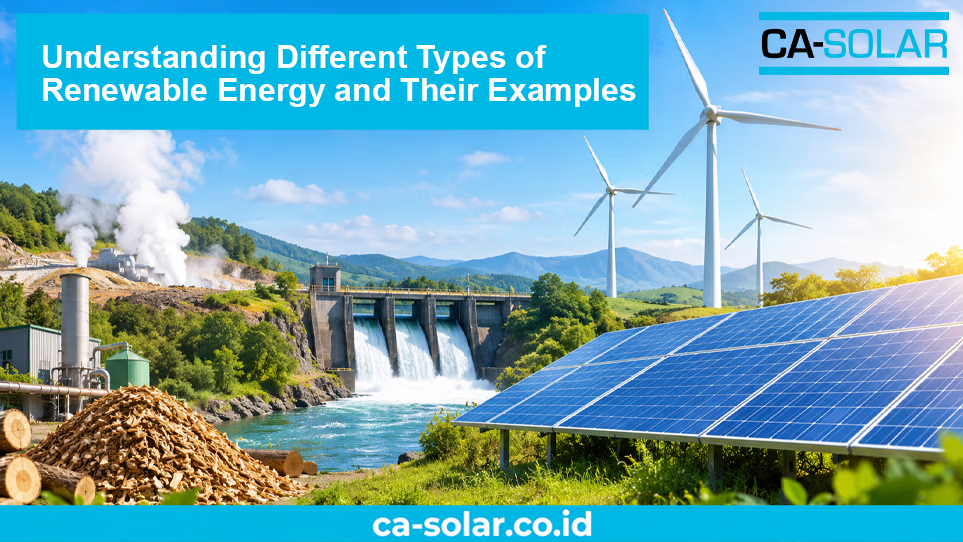
One approach that has developed to address these challenges is the utilization of renewable energy. Unlike fossil energy sources that are formed over very long periods, renewable energy comes from natural resources that can be replenished through natural processes, such as sunlight, wind, water flow, biomass, and heat from within the earth.
So, what are the types of renewable energy currently known, and how is each energy source utilized?
What Is Renewable Energy?
Renewable energy is energy derived from natural resources that can regenerate or become naturally available again within a relatively short period of time compared to fossil energy sources.
These energy sources have different characteristics. The sun produces radiation that can be utilized to generate electricity, wind has kinetic energy that can drive turbines, while water flow can be used to turn hydroelectric power generation turbines.
Because they come from natural sources that continue to be available through natural processes, renewable energy is an important part of discussions surrounding energy source diversification and the energy transition.
Its utilization is also not limited to a single sector. Renewable energy can be used to generate electricity, provide heat, and support various other energy needs.
1. Solar Energy
Solar energy is energy derived from solar radiation. This energy source can be utilized through various technologies, one of which is a solar panel, which converts sunlight into electrical energy.
In a photovoltaic system, solar cells contained within the panel receive solar radiation and generate electrical energy. This electricity can then be used directly or integrated into an electrical system according to the configuration of the installation.
One characteristic of solar energy is that its energy source is available across a wide geographical area. This allows solar panel technology to be applied to various types of buildings, ranging from homes and commercial facilities to industrial rooftops.
However, the utilization of solar energy also needs to consider site conditions, installation orientation, available area, roof characteristics, energy requirements, and the overall system configuration. Therefore, discussions about solar energy are not only related to panels but also include the mounting system that supports and positions the panels.
In an installation, a solar mounting system functions as the mounting structure for solar panels. Components such as solar profiles, clamps, foot brackets, and join bars can be used to form a mounting structure according to system requirements.
The development of solar energy is also closely related to industrial needs. Factories and production facilities with large rooftop areas can utilize these areas as locations for solar power system installations while still considering building structural conditions and installation requirements.
2. Wind Energy
Wind energy comes from the movement of air masses in the atmosphere. This movement contains kinetic energy that can be utilized using wind turbines.
When wind passes through the turbine blades, the kinetic energy of the wind causes the blades to rotate. The rotation is then used to drive a generator to produce electrical energy.
Wind power plants generally require locations with favorable wind characteristics. Therefore, factors such as wind speed, wind patterns, geographical conditions, and available area are important considerations in power plant planning.
Wind energy can be utilized at different scales. In areas with suitable wind conditions, turbines can be installed in certain quantities to form wind power generation facilities.
Unlike solar energy, which is highly dependent on sunlight intensity, wind power generation depends on the characteristics of the wind at a particular location. These differences in characteristics show that each type of renewable energy has different application conditions.
3. Hydropower
Hydropower utilizes the movement or flow of water to generate energy. One of the most well-known applications is hydroelectric power generation.
In a hydropower plant, water flow is used to drive turbines. The rotating turbines then drive generators to produce electricity.
In addition to large-scale hydropower plants, there are also smaller-scale power plants that utilize specific water flow conditions. The selection of the system depends heavily on the characteristics of the water source and the geographical conditions of the location.
Hydropower has different characteristics from solar and wind energy because its production is closely related to the availability and characteristics of the water source. Therefore, the development of hydropower facilities requires appropriate site and infrastructure planning.
4. Geothermal Energy
Geothermal energy comes from heat found within the earth. This heat can be found in various regions and, under certain conditions, can be utilized to generate energy.
Geothermal power plants utilize heat from geothermal reservoirs to produce steam or hot fluids, which are then used in the electricity generation process.
Geothermal energy has an interesting characteristic because its heat source comes from geological processes within the earth. However, its utilization is highly dependent on the geological conditions of a particular region.
Indonesia itself has geothermal potential related to its geological conditions. Nevertheless, the development of geothermal projects requires exploration, geological studies, infrastructure development, and investment appropriate to the characteristics of the project.
5. Biomass Energy
Biomass refers to organic materials that can be utilized as an energy source. These sources can come from plants, agricultural waste, forestry waste, and other organic materials suitable for use as fuel or energy feedstock.
Energy from biomass can be obtained through various processes. Certain organic materials can be burned directly to produce heat, while other materials can be processed to produce fuel or biogas.
One important aspect of biomass utilization is the availability of feedstock. For the system to operate sustainably, the supply of biomass needs to be managed by considering availability, collection, transportation, processing, and utilization.
Because it comes from organic materials, biomass is also related to waste management and resource utilization. In an industrial context, waste from certain production activities has the potential to be reused as an energy source if the characteristics of the material and processing system allow it.
6. Marine Energy
The ocean has various forms of energy that can be utilized, including energy from waves, tides, and the movement of seawater.
Tidal energy utilizes changes in sea levels caused by the gravitational interaction of the earth, moon, and sun. Meanwhile, wave energy utilizes the movement of ocean waves to generate energy.
There are also technologies that utilize differences in seawater characteristics under certain conditions. However, the development of marine energy has its own challenges because the systems must operate in marine environments that are corrosive and dynamic and require specialized infrastructure.
Therefore, marine energy technology still has different development characteristics compared with more commonly used renewable energy technologies such as solar, wind, hydropower, and geothermal energy.
7. Hydrogen Energy and the Position of Hydrogen in Renewable Energy
Hydrogen is often discussed in the context of the energy transition, but it is necessary to distinguish hydrogen as an energy source or carrier from renewable energy sources such as sunlight and wind.
Hydrogen can be used as an energy carrier that allows energy to be stored and reused in different forms. One type that is widely discussed in the context of clean energy is green hydrogen, which is hydrogen produced using electricity from renewable energy sources through the electrolysis process.
With this approach, energy from sources such as sunlight or wind can be used to produce hydrogen. Hydrogen can then be stored and utilized according to requirements.
This technology opens up possibilities for using renewable energy in a wider range of sectors, although its implementation has its own infrastructure and technological requirements.
Differences in the Characteristics of Each Type of Renewable Energy
Although they are all classified as renewable energy, each energy source has different characteristics. These differences can be seen in the energy source, required location, technology used, and conditions that affect its production.
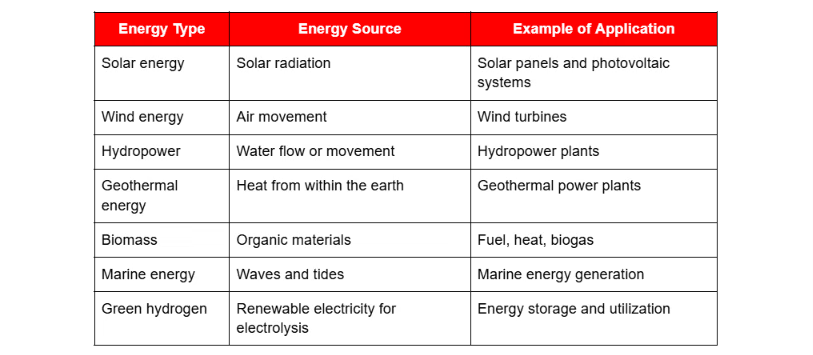
Because their characteristics differ, the selection of renewable energy technology cannot be based solely on the type of energy source. Geographical conditions, energy requirements, infrastructure, investment, and usage characteristics also need to be considered.
Why Is Renewable Energy Important for Industry?
Industries require significant amounts of energy to carry out various activities, ranging from production processes, cooling systems, and lighting to the operation of machinery and equipment.
Dependence on a single energy source can make companies more vulnerable to changes in supply conditions and energy costs. Therefore, diversification of energy sources is one aspect that can be considered in an energy management strategy.
Renewable energy can be part of such a strategy. One example that is receiving increasing attention is the utilization of solar energy on the rooftops of industrial facilities.
Factories and warehouses often have relatively large roof areas. These areas can be utilized for solar panel system installations as long as the building condition, roof structure, orientation, and other technical aspects meet the installation requirements.
In this context, how to determine solar panel capacity according to electricity needs is one aspect that needs to be considered. System capacity should not be determined solely based on the available area but should also take energy requirements and the overall system characteristics into account.
In addition to the panels, the mounting structure is also an important part of the system. The solar panel frame must be able to support the installation of the panels in the planned position while also being adapted to the characteristics of the location.
Solar Energy as One Option for Buildings and Industry
Among the various types of renewable energy, solar energy has characteristics that allow it to be applied to various types of buildings.
Solar panels can be installed on the rooftops of homes, commercial buildings, warehouses, and industrial facilities. Their application can also be combined with a mounting system designed according to site conditions.
In rooftop systems, the mounting structure needs to be adapted to the type and condition of the roof. Meanwhile, in ground-mounted installations, the structure is installed on the ground with a different configuration.
These different requirements make mounting system design an important part of installation planning. For example, the difference between solar panel frames for rooftop and off-grid systems can be a consideration when determining a structure suitable for the installation location.
A modular mounting system also provides flexibility when an installation requires certain configurations or future expansion. The modular concept allows several components to be used as a single system that can be adjusted according to installation requirements.
The Role of Solar Mounting Systems in Utilizing Solar Energy
Solar panels generate electricity by utilizing solar energy, but the panels still require a mounting structure so they can be positioned in a suitable location.
This is where the solar mounting system plays a role.
A solar mounting system is a structure used to support and install solar panels. The system can consist of several interconnected components, such as solar profiles, mid clamps, end clamps, foot brackets, and join bars.
The solar profile functions as part of the main structure where the panels are installed. Mid clamps and end clamps are used to help secure the panels in position on the structure, while foot brackets can serve as connecting components between the mounting structure and the mounting surface. Join bars are used when connecting sections of the profile is required in a particular configuration.
Material selection is also one aspect that needs to be considered. Aluminum alloy and stainless steel can be used for various components of the mounting system, each with its own characteristics.
In addition to materials, environmental conditions also need to be considered. A system installed in an area with certain weather exposure will face different conditions from a system installed in another environment. Therefore, factors affecting the durability of solar panel frames are an important part of mounting system planning.
The Importance of Planning Before Using Renewable Energy
Utilizing renewable energy is not only about choosing an available energy source. System planning needs to consider the relationship between the energy source, conversion technology, location, energy requirements, and supporting infrastructure.
For a solar power system, for example, planning may include determining the panel location, required capacity, installation design, mounting structure, and maintenance methods.
Errors during the planning stage can affect the installation process and long-term system use. Therefore, common mistakes when installing solar panel frames need to be understood from the beginning, especially when the system will be installed on buildings or facilities with significant energy requirements.
Planning also needs to consider environmental conditions. A system located in a coastal area, for example, will face different environmental conditions from a system located in an urban area or inland region. Environmental exposure can be one of the factors that needs to be considered when selecting materials and structural designs.
The Development of Renewable Energy and the Future of Energy Systems
Technological developments are making the utilization of renewable energy increasingly diverse. Future energy systems will not depend on a single technology but may involve a combination of several energy sources and energy storage technologies.
Solar and wind energy, for example, can be used as sources of electricity generation, while energy storage technologies can help manage the electricity produced according to demand. On the other hand, hydrogen can serve as a form of energy storage or an energy carrier for certain applications.
For the industrial sector, these developments create opportunities to develop more diverse energy strategies. Renewable energy utilization can be linked to energy efficiency, operational cost management, and corporate sustainability strategies.
This concept is also aligned with the development of green manufacturing, as companies increasingly consider how production processes can be carried out using resources more efficiently and through more sustainable approaches.
Conclusion
Renewable energy includes various energy sources that can be naturally replenished, ranging from solar, wind, hydropower, geothermal, and biomass to marine energy. Each has different characteristics, technologies, location requirements, and implementation challenges.
Among these various types, solar energy has broad applications because it can be utilized at various scales, including homes, commercial buildings, and industrial facilities. Its utilization does not depend solely on solar panels but also requires supporting systems such as a solar mounting system that is suitable for the site conditions and installation design.
As attention to energy efficiency and sustainability continues to increase, understanding various renewable energy sources is an important step toward seeing how energy needs can be met through a combination of suitable technologies. For the industrial sector, this approach can become part of an energy management strategy while also supporting the development of more sustainable production systems.