Signs Your Solar Mounting Needs Replacement and How to Identify Them
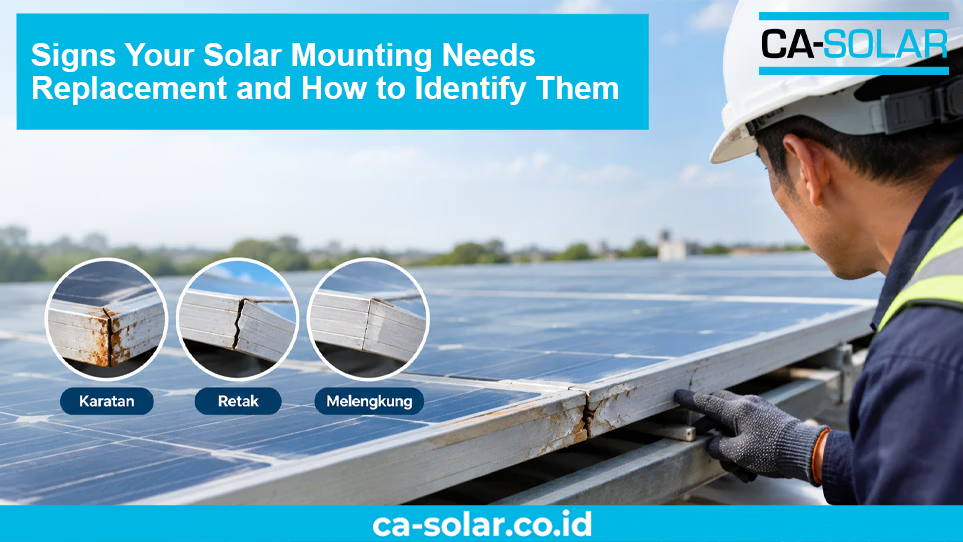
Solar panels are designed for long-term use. However, it is not only the panels that need attention. The solar panel frame or solar mounting also plays a vital role in keeping the panels securely and stably installed at the location.
Over time, the frame can undergo various changes due to weather exposure, environmental conditions, usage, or component damage. If these conditions are ignored, mounting issues can affect the safety and stability of the entire system.
So, how can you tell if a solar panel frame is still suitable for use or needs to be replaced? Here are several signs to watch out for:
1. Visible Corrosion or Material Damage
One of the easiest signs to spot is the appearance of corrosion or surface damage on frame components. Environmental conditions such as high humidity, water, salty coastal air, or specific environmental exposure can affect material conditions over time.
However, the appearance of surface changes does not always mean the entire frame must be replaced immediately. The condition needs to be inspected first to determine whether the issue is only on the surface layer or has affected structural parts.
Material selection from the start is also an important factor. Aluminum is widely used in mounting systems because of its relatively light weight and good corrosion resistance.
2. The Frame Starts Deforming or Warping
Check whether the Solar Profile or other parts of the frame appear bent, warped, or deformed unnaturally.
Deformation can occur due to load, impacts, installation errors, or specific environmental conditions.
A frame that has undergone deformation requires further inspection. If the shape change affects panel position or stability, replacing components can be a safer choice than maintaining damaged parts.
3. Solar Panels Are No Longer in Their Proper Position
The frame functions to help maintain the panel position according to the installation design. If over time the panels appear shifted, misaligned, or the spacing between panels starts to change, do not just check the panels. Also check the mounting system supporting them.
Issues can stem from connections, clamps, Solar Profiles, or the frame's attachment points to the building structure. In such conditions, it is important to identify the root cause first before deciding whether simple adjustments are sufficient or if specific components need replacement.
4. Repeated Issues with Connections or Fasteners
A mounting system consists of several components working together to keep panels in place. If connections frequently loosen, fasteners suffer damage, or parts are no longer properly attached, this condition should not be ignored.
An issue with a single component does not necessarily mean the entire frame must be replaced. However, if damage recurs or impacts system stability, a comprehensive inspection needs to be conducted to determine which components need repair or replacement.
Components like End Clamps, Mid Clamps, Foot Brackets, and Joint Bars serve different functions in the mounting system, so each component's condition should be checked according to its role.
5. Physical Damage to the Frame
Physical damage such as cracks, breaks, detached parts, or impacted components are signs that must not be ignored.
This is especially true if damage occurs on main parts that support the panel or connect the frame to mounting points.
In such conditions, using the frame without inspection can increase risks to panel stability. Damaged components must be evaluated and, if no longer fit for use, should be replaced.
6. Frame Condition No Longer Matches Installation Needs
Solar panel system requirements can change over time. For example, the installation owner may want to add more panels, alter the configuration, or expand the system into previously unused areas.
In these situations, the old frame does not necessarily need to be completely dismantled. A modular mounting system provides flexibility because the frame can be expanded by adding matching components.
This differs from situations where the old frame has suffered structural damage. If the main material or components are no longer fit, replacement must still be considered.
7. Significant Decline in Frame Condition
Not all damage appears in an immediately visible form. Frames can undergo gradual degradation due to long-term use and environmental exposure. Therefore, periodic inspections remain essential even if the frame looks fine from a distance.
Thoroughly check the condition of Solar Profiles, clamps, brackets, connections, and mounting points.
If multiple issues are found simultaneously, do not just replace the most visible component. Evaluate the entire system to determine whether partial repairs are sufficient or full frame replacement is the better choice.
When Does a Solar Panel Frame NOT Need Immediate Replacement?
Finding an issue with the frame does not always mean the entire system must be replaced.
Some conditions can still be resolved through inspection, tightening connections, replacing specific components, or making repairs according to installation conditions.
Conversely, replacement should be considered if damage has affected the main structure, panel stability, or overall system safety.
Therefore, replacement decisions should not be based solely on frame age, but also on actual material condition, components, connections, and installation location.
How to Choose the Right Replacement Frame?
If the frame indeed needs replacement, choosing a replacement system should not be based solely on price. Several factors need to be considered, such as:
- Frame material
- Environmental conditions at the installation site
- Mounting type, such as rooftop or ground mounting
- Panel size and configuration
- Installation method
- Compatibility between components
- Ease of future system expansion
Material selection also needs to align with project requirements. Aluminum, for instance, is widely used in mounting systems due to its lightweight nature, corrosion resistance, and suitability for modular systems.
To learn more about the differences in materials that can be used, you can read about the best materials for solar panel frames to understand the characteristics of aluminum and steel in mounting systems.
Modular Systems Simplify Expansion and Component Replacement
One advantage of modular mounting systems is flexibility.
Damage to one part does not always require the entire system to be dismantled. Specific components can be inspected and replaced as needed, provided the replacement system is compatible with the entire frame.
This concept also offers convenience when system expansion is needed in the future.
CA-Solar provides modular mounting systems consisting of Solar Profiles, Mid Clamps, End Clamps, Foot Brackets, and Joint Bars. Each component is designed to function as part of a flexible solar panel frame system adaptable to installation needs.
Don't Wait Until the Frame Is Severely Damaged
The solar panel frame is a vital component supporting the panels throughout system use. Therefore, shape changes, corrosion, physical damage, connection issues, or panel displacement should not be considered minor issues.
The sooner frame conditions are identified, the easier it is to determine whether issues can still be handled through repairs or require component replacement.
With proper inspection and selecting a suitable mounting system, your solar panel frame can keep the installation stable and functional according to your needs.
CA-Solar provides modular solar mounting systems with aluminum and stainless steel components for various solar panel installation needs.