How Does Solar Panel Generate Electricity?
What Are Solar Panels Made Of?
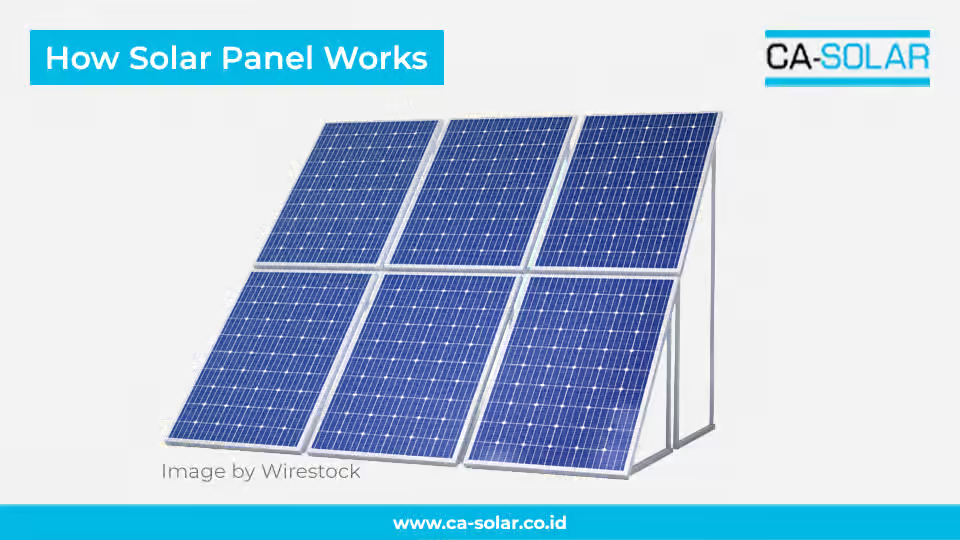
Solar panels are made from a combination of solar cells, silicon, metal, and glass. Many people often ask what are solar panels made of, especially when trying to understand how this technology can generate electricity from sunlight. In general, solar panels consist of several key components that work together to capture and convert solar energy into electricity.
Solar cells are usually made from silicon, which is cut into thin wafers to form monocrystalline solar panels. Photovoltaic (PV) cells generate electricity from sunlight, while thin-film solar cells are produced by depositing one or more layers of PV material onto a supporting surface such as glass, plastic, or metal.
Types of Solar Panels
There are three main types of solar panels commonly used today:
- Monocrystalline solar panels – highly efficient and widely used for commercial applications
- Polycrystalline solar panels – more affordable but slightly less efficient
- Thin-film solar panels – the least efficient option but also the most economical
How Solar Panels Work
Solar panels work by allowing photons, or particles of light, to knock electrons free from atoms, generating an electric current. This process is known as the photovoltaic effect and occurs when sunlight hits the silicon material in the solar panel.
To better understand this process, it is important to know what are solar panels made of, since semiconductor materials such as silicon allow electrons to move and produce electrical current.
Solar panels convert energy from the sun into electricity and heat through photovoltaic (PV) cells. These cells use the photovoltaic effect to transform incoming sunlight photons into usable electricity. The process generally involves several steps:
- Sunlight strikes the solar panel
- Solar cells generate an electric current
- The electrical energy is converted into usable power
- The converted energy is used by electrical devices
Solar Panel Efficiency
Solar panels generate electricity when photons release electrons from atoms, creating a flow of electric current. This current is then sent through cables to an inverter, where it is converted into usable electrical energy.
Solar panels typically have a conversion efficiency of around 15–22%, with some advanced technologies reaching up to 23%. This means that solar panels can convert a portion of the sunlight they receive into usable energy.
By understanding what are solar panels made of, we can see how each component in a solar panel plays an important role in converting sunlight into electricity efficiently.