How Solar Mounting Systems Work to Hold Solar Panels in Place
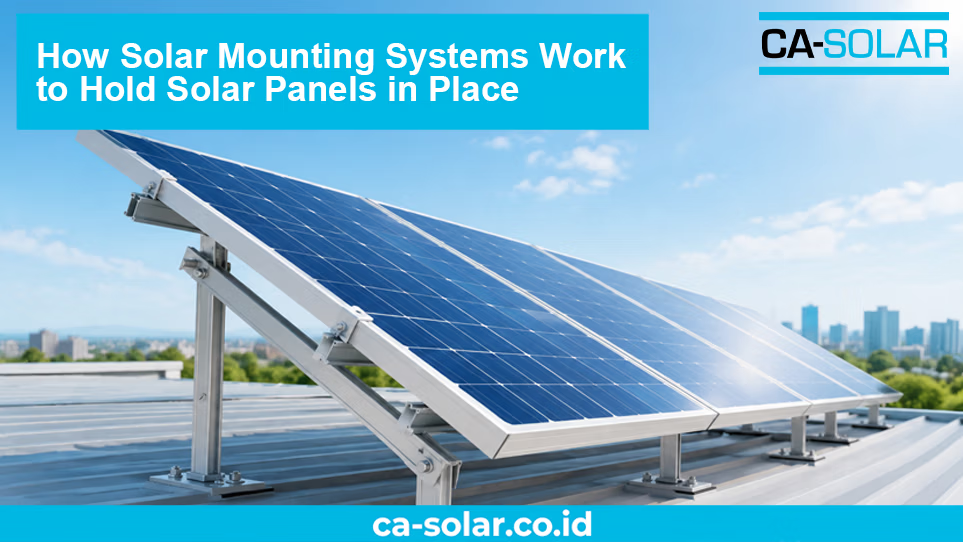
Solar panels are designed to capture sunlight and convert it into electrical energy. However, to function properly, solar panels require a support system that can maintain their position and stability during operation. This is where a solar mounting system plays an important role in a solar installation.
A solar mounting system is a framework and component assembly used to support solar panels on rooftops or on the ground. This system does more than simply provide a place to install the panels; it also helps maintain their position when exposed to environmental influences, such as wind and changing weather conditions.
So, how does a solar mounting system work to hold solar panels in place? What components help maintain installation stability? Let's explore the details below.
What Is a Solar Mounting System?
A solar mounting system is a supporting structure used to install solar panels at designated installation locations. This system consists of a framework and fastening components that work together to support the panels and maintain their position. In solar installations, mounting systems are generally used for two types of installations:
- Rooftop mounting: A framework installed on a building's roof, with the installation method adjusted to the type and construction of the roof.
- Ground mounting: A framework installed on the ground using a supporting structure designed according to the conditions of the installation site.
Although they are installed in different locations, both systems serve the same purpose: providing stable support and keeping solar panels in their intended positions.
How Does a Solar Mounting System Work to Hold Solar Panels in Place?
A solar mounting system works through a combination of frames, fastening components, and mounting points that create a load path from the solar panels to their supporting structure. The following explains how the system works.
1. The Frame Provides the Main Support for Solar Panels
The frame is the main component that supports solar panels. It forms the structure on which the panels are installed and helps maintain their arrangement according to the installation design. The frame must be designed by considering the size and weight of the panels, the spacing between supports, the installation configuration, and the environmental conditions at the installation site.
In rooftop systems, the frame transfers the panel loads to the mounting points on the roof structure. Meanwhile, in ground-mounted systems, the frame transfers the loads to the supporting structure and foundation. With a properly designed configuration, the frame helps keep the panels supported without relying on a single support point.
2. Mid Clamps and End Clamps Maintain Panel Position
In addition to the frame, fastening components play an important role in keeping solar panels in position and preventing them from shifting from their intended arrangement. Two components commonly used in solar panel mounting systems are mid clamps and end clamps.
Mid clamps are used to clamp the edges of two adjacent panels. These components help maintain the position of panels located within the middle of an array.
Meanwhile, end clamps are used to secure the edges of panels located at the ends of an array. These components help keep the panels in position at the ends of the mounting structure.
Both components work together with the mounting profiles to keep the panels installed according to the system configuration. Clamp selection must be compatible with the mounting profile, panel frame thickness, and specifications of the mounting system being used.
3. Solar Profiles Transfer Loads to the Supporting Structure
A solar profile is part of the mounting frame where the fastening components and solar panels are installed. This profile helps support the panels while transferring loads to the underlying structural components. When a panel experiences loads from its own weight or environmental influences, those loads are transferred through the mounting points and profiles to the supporting structure.
Therefore, selecting a solar profile should involve more than considering its shape or ease of installation. Profile dimensions, material characteristics, support spans, and frame configurations must also be considered to ensure suitability for the installation requirements.
Aluminium profiles are widely used in solar mounting systems because their characteristics support the requirements of solar panel mounting structures. However, profile suitability must still be determined based on the calculations and specifications of the system being used.
4. Mounting Points Connect the Frame to the Building Structure or Ground
The frame and clamps do not operate independently of the structure on which the panels are installed. Mounting points connect the mounting system to the roof structure or the supporting structure above the ground. In rooftop installations, the connections must be suitable for the roof type and building structure. In ground-mounted installations, the supporting structure and foundation must be designed to transfer loads to the ground.
This part is particularly important because a sturdy frame does not necessarily result in a stable installation if its connections or mounting points are unsuitable. Therefore, the selection of installation methods, fastener types, and connection details must take the actual structural conditions into account.
5. All Components Work Together as One System
The stability of solar panels is not determined by a single component. The frame, clamps, connections, and supporting structure must work together as an integrated system. When wind exerts pressure or uplift forces on the panel surface, these forces can be transferred through the panels, fastening components, profiles, connections, and supporting structure to the foundation.
This load path must be designed so that each component can perform its intended function within its calculated capacity. As a result, a properly designed solar mounting system helps keep panels securely installed and reduces the risk of displacement, deformation, or connection failure caused by loads that exceed the system's capabilities.
Factors That Affect a Solar Mounting System's Ability to Hold Solar Panels
A solar mounting system's ability to support solar panels is influenced by several factors that must be considered during the planning stage.
1. Wind Loads at the Installation Site
Wind can exert pressure and uplift forces on solar panels, particularly when they are installed on rooftops or in open areas. The impact of wind depends on site conditions, installation height, building shape, panel orientation, and frame configuration.
Therefore, the mounting system design must account for the relevant wind conditions at the installation site rather than considering only the weight of the panels.
2. Frame Material Quality and Dimensions
The material and dimensions of the profiles affect the frame's ability to support loads. Material selection must consider mechanical properties, corrosion resistance, the installation environment, and structural requirements.
In addition to the material, the span length and spacing between supports also affect how the frame behaves under load.
3. Clamp and Connection Compatibility
Clamps that are incompatible with the panel frame or mounting profile can compromise the fastening function. Similarly, connections that are not properly designed or installed can become weak points in the load path.
Therefore, fastening components must be selected based on compatibility and installation specifications, and they must be installed according to the applicable technical instructions.
4. Roof or Foundation Conditions
The supporting structure must be capable of receiving the loads transferred by the mounting system. In rooftop installations, the condition and capacity of the roof structure must be assessed. In ground-mounted installations, soil conditions and foundation design are important parts of the planning process.
These assessments help ensure that the installation system is stable not only at the frame level but also at the structure on which it rests.
5. Design Accuracy and Installation Quality
An appropriate design must be followed by correct installation procedures. Errors in support spacing, clamp positioning, fastener tightening, or connection installation can affect the stability of the entire system.
Therefore, installation must follow the specified drawings, component specifications, and installation procedures.
Why Should You Choose a Solar Mounting System Carefully?
A solar mounting system is an important part of the overall solar panel installation. Choosing a system based solely on price or ease of installation may overlook structural requirements and environmental conditions.
A suitable mounting system helps maintain panel position, supports installation stability, and reduces the risk of damage caused by improper design or installation. Before selecting a mounting system, several factors should be evaluated, including:
- The installation type, whether rooftop or ground mounting.
- The size, weight, and configuration of the solar panels.
- Environmental conditions and wind loads at the installation site.
- Compatibility between the solar profiles, mid clamps, end clamps, and connection components.
- The capacity of the roof structure or foundation.
- Corrosion resistance requirements and operating conditions.
- The ease of system inspection and maintenance.
By considering these factors, the mounting system can be designed to meet the specific requirements of a project rather than simply replicating the configuration used in another installation.
CA-Solar: Solar Mounting System Component Solutions
CA-Solar provides solar mounting system components to support solar panel installations on buildings and in open areas. Available products include Solar Profiles, Mid Clamps, End Clamps, Foot Brackets, and Join Bars, which can be used according to the requirements of the installation configuration.
CA-Solar components use aluminium alloy and stainless steel in relevant products, with material selection depending on the function of each component. Solar mounting systems can be planned using a modular approach to help adapt the frame arrangement to project requirements.
When selecting the appropriate mounting components, it is important to consider compatibility between components, site conditions, and the structural requirements of the installation.
FAQ: Frequently Asked Questions About Solar Mounting Systems
Can a solar mounting system prevent solar panels from coming loose in strong winds?
A solar mounting system is designed to support and secure solar panels. Its ability to withstand strong winds depends on the structural design, component specifications, connection quality, installation method, and site conditions. Therefore, the system must be designed based on appropriate wind load calculations.
What are the functions of mid clamps and end clamps in solar panel installations?
Mid clamps are used to clamp the edges of two adjacent panels, while end clamps secure the edges of panels at the ends of an array. Both help maintain panel position on the frame when selected and installed according to the system specifications.
Do solar mounting systems have to use aluminium?
Not necessarily. Material selection depends on the structural design, load requirements, installation environment, and product specifications. Aluminium is widely used for mounting profiles, while other materials may be used for specific components according to their functions and system requirements.
How can you ensure that a solar mounting system is safe to use?
Ensure that the system is designed for the relevant loads, uses compatible components, and is installed on an adequate supporting structure. Inspections should also cover connections, mounting points, material conditions, and compliance with technical installation specifications.
Conclusion
A solar mounting system works by combining the functions of frames, clamps, connections, and supporting structures to keep solar panels in their intended positions. Each component has its own role in supporting the panels and transferring loads to the building structure or foundation.
The system's ability to hold solar panels is determined not only by frame strength but also by material suitability, structural design, wind loads, connection quality, and installation accuracy.
By selecting compatible components and planning the installation according to site conditions, a solar mounting system can support a stable and reliable solar panel installation for long-term use.
Need solar mounting system components for your solar panel project? Visit CA-Solar to explore Solar Profiles, Mid Clamps, End Clamps, Foot Brackets, and Join Bars that can be adapted to your installation requirements.