Function of Join Bars on Solar Panel Frames and How it Work
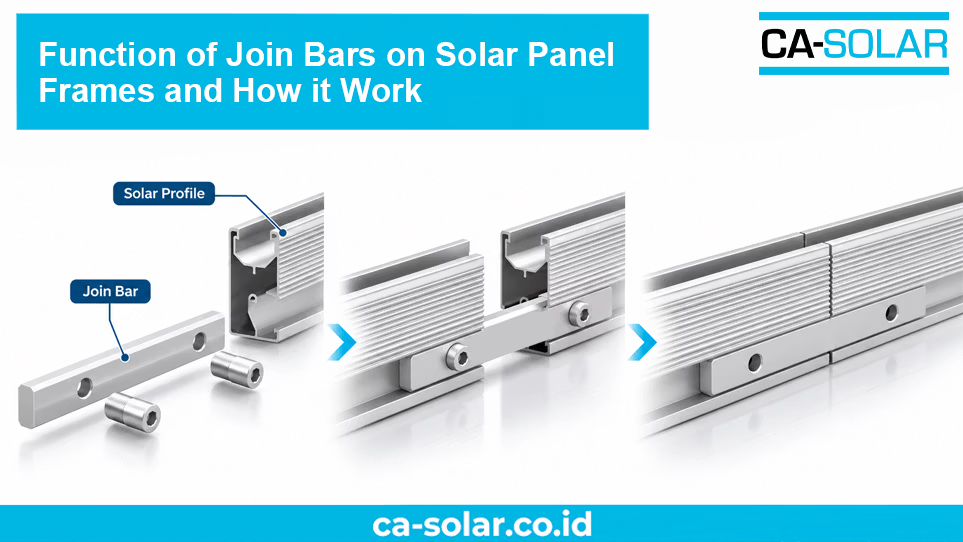
In solar panel installations, the frame or solar mounting system serves as a supporting structure that helps keep the panels stable. One of the components supporting the assembly of this frame is the Join Bar, a connecting component used to join parts of the Solar Profile according to installation needs.
The use of a Join Bar becomes essential when the required frame length cannot be satisfied by a single length of Solar Profile or when the mounting design requires connections between profiles. With properly planned connections, the solar panel frame can be assembled according to the required dimensions and installation configuration.
So, what is the function of the Join Bar on a solar panel frame, how does it work, and what should be taken into consideration during installation?
What Is a Join Bar in a Solar Mounting System?
A Join Bar is a connecting component used to link two sections of Solar Profile within a solar panel frame system. This component helps join profiles together so they can be arranged according to the planned length and frame configuration.
In a solar mounting system, the Solar Profile functions as part of the supporting structure for the solar panels, while the Join Bar helps connect sections of the profile when a connection is required. Both have different functions, but they complement each other in the frame assembly process.
The selection of a Join Bar needs to be tailored to the type of Solar Profile used, the installation design, and the manufacturer's installation guidelines. In this way, the connection can be planned as part of the overall framing system, rather than merely joining two profile bars together.
Functions of the Join Bar on a Solar Panel Frame
There are several functions of the Join Bar that need to be understood before planning a solar panel installation.
1. Connecting Two Solar Profiles
The primary function of the Join Bar is to help join two sections of Solar Profile into a single, longer profile sequence. This is useful when the required frame dimensions exceed the available profile length.
With an appropriate connection, the arrangement of the Solar Profile can follow the installation design requirements without having to use a single long profile bar for the entire frame section.
2. Supporting Flexibility in Frame Assembly
Every solar panel installation project can have different dimensions and configurations. The Join Bar provides a joining option when the Solar Profile layout requires more than one profile bar.
This need can be found in rooftop installations as well as ground mounting systems, depending on the planned structural design and dimensions. The use of a Join Bar must still adhere to the design of the mounting system being used.
3. Helping Arrange Profiles According to Installation Dimensions
Frame planning needs to consider the size of the installation area, the layout of the panels, and the requirements of the supporting structure. When the available profile length is insufficient, a connection can serve as a solution to adapt the Solar Profile assembly to the installation dimensions.
However, the presence of a Join Bar does not automatically guarantee the strength or durability of the connection. The final result is still influenced by component compatibility, connection position, installation method, and the technical requirements of the mounting system.
How Does a Solar Panel Join Bar Work?
In general, the working principle of a Join Bar begins with connecting two sections of Solar Profile using components that match the mounting system design. The detailed mechanism may vary depending on the profile shape and the specifications of the Join Bar used.
Here is an overview of the process:
1. Determining the required Solar Profile length
Determine the frame dimensions based on the installation design and the position of the solar panels. From these calculations, it can be determined whether a single profile bar is sufficient or if a connection is needed.
2. Determining the connection position
The position of the Join Bar needs to be planned based on the frame design and the manufacturer's technical instructions. Connections should not be placed arbitrarily, especially if that position could affect load distribution across the structure.
3. Connecting the Solar Profile using the Join Bar
The Join Bar is installed onto the Solar Profile sections according to the designed connection mechanism. Ensure that the components used are compatible with the respective profile and that the entire process follows the installation instructions.
4. Checking alignment and installation
After the connection is made, check the profile alignment, the position of the joint, and the compliance of the installation with the design. Inspection must also ensure that the connection meets the technical requirements of the system being used.
Through these steps, the Join Bar helps in the process of arranging the Solar Profile to match the planned solar panel frame configuration.
When Does a Solar Panel Frame Connection Require a Join Bar?
Not all solar panel installations require a Join Bar. Its use depends on the profile length, frame design, and the selected mounting system. Some conditions that may require a Join Bar include:
- The frame length exceeds the available profile length. Connections are needed when the planned dimensions require more than one length of Solar Profile.
- The installation design requires connections between profiles. Certain frame configurations may require joints according to technical design specifications.
- Material planning requires a modular profile layout. In systems designed using multiple profile sections, a Join Bar can be used if that connection method is specified in the design.
Before deciding to use a Join Bar, check the working drawings and specifications of the mounting system first. If the joint is located in a section that bears significant load, its placement must be determined based on relevant calculations and technical rules.
Things to Consider When Installing a Join Bar
To ensure that the Solar Profile connection meets installation requirements, several factors must be considered.
1. Ensure Compatibility Between the Join Bar and Solar Profile
Not all connecting components are suitable for every type of profile. Verify the dimensional, shape, and technical specification compatibility of the Join Bar relative to the Solar Profile being used.
2. Follow the Manufacturer's Installation Instructions
The installation method, joint positioning, and fastener requirements must strictly follow the product's technical guidelines. Avoid improvising installation methods that are not listed in the system specifications.
3. Pay Attention to Connection Positioning
Joint placement must take into account the frame design, load distribution, and installation conditions. Do not assume that any section of the Solar Profile can be joined at any position without checking technical requirements.
4. Check Profile Alignment
The two profile sections being connected must be positioned in accordance with the design. Alignment helps the assembly process run more smoothly and reduces the risk of dimensional mismatches during panel installation.
5. Consider Environmental and Structural Conditions
Solar panel installations can face various environmental conditions, including weather exposure and wind loads. Therefore, the connection must be planned as part of the overall structural plan, rather than evaluated solely as an isolated Join Bar component.
Choose the Right Join Bar and Solar Profile for Your Solar Panel Installation
Join Bars and Solar Profiles are two complementary components in solar panel frame construction. The Solar Profile serves as part of the supporting structure, while the Join Bar is used to connect profiles when required by the installation design.
CA-Solar provides solar mounting components, including Join Bars and Solar Profiles, to support your solar panel mounting system assembly needs. Selecting the appropriate components requires considering frame dimensions, component compatibility, and project technical specifications.
Before selecting components, make sure the required profile lengths and connection methods have been thoroughly planned. With proper planning, the choice of Join Bars and Solar Profiles can be tailored to the specific installation needs, whether for rooftop or ground-mounting projects.