Differences Between Rooftop and Off Grid Solar Panel Mounting Systems
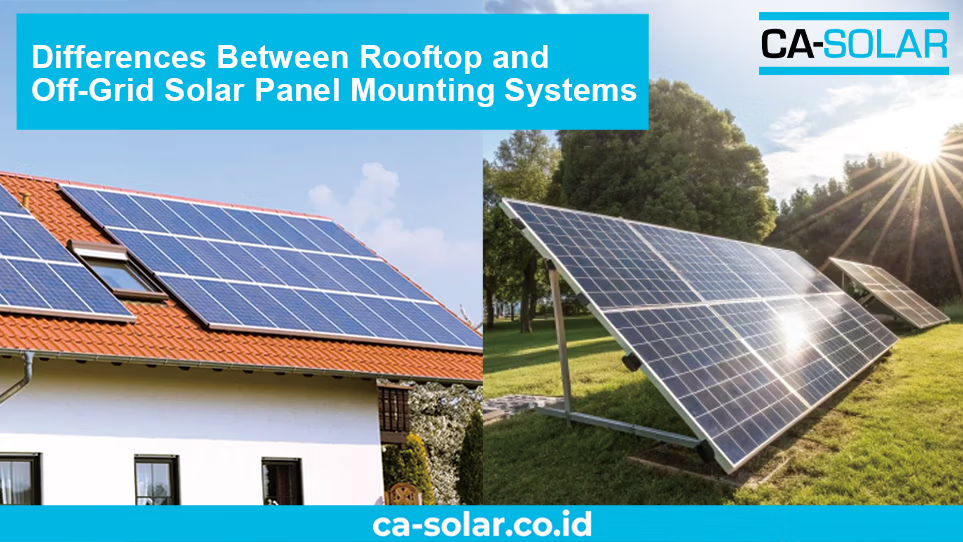
In solar power installations, the mounting structure plays a crucial role in ensuring stability, efficiency, and ease of installation. In general, there are two main types of systems commonly used: rooftop and off-grid. Each system has different characteristics depending on project requirements and installation conditions.
1. Rooftop Solar Panel Mounting System
A rooftop solar panel mounting system is installed on top of a building, such as residential houses, commercial buildings, or industrial facilities. Key characteristics of rooftop systems:
- Installed following the roof structure
- Utilizes existing space
- Does not require additional land
- Suitable for small to medium-scale energy needs
2. Off-Grid Solar Panel Mounting System
An off-grid solar mounting system is typically installed on the ground or open areas and does not rely on existing buildings. Key characteristics of off-grid systems:
- Installed on dedicated land
- Uses a standalone structure
- Allows optimal angle and orientation adjustment
- Suitable for large-scale or remote projects
3. Differences in Installation Location
Rooftop :
- Installed on building roofs
- No additional land required
- Limited by available roof space
Off-Grid :
- Installed on ground or open areas
- Requires dedicated land
- Offers more flexibility in positioning
4. Differences in Structural Design
Rooftop :
- Follows the slope and structure of the roof
- Designed to adapt to existing building conditions
- Requires a lightweight and practical system
Off-Grid :
- Designed as an independent structure
- More flexible in configuration
- Can utilize modular systems for easier assembly
In modern mounting systems, the use of modular aluminium profiles has become one of the solutions to improve efficiency and ease of installation. This approach is also implemented in CA Solar systems, which are designed to be lightweight, easy to assemble, and minimize on-site work.
5. Differences in System Requirements
Rooftop :
- Focus on space efficiency
- Quick and practical installation
- Commonly used for daily energy needs
Off-Grid :
- Focus on capacity and flexibility
- Used for large-scale projects
- Suitable for areas without grid access
6. Differences in Installation Challenges
Rooftop :
- Limited installation access
- Must consider roof strength
- Requires lightweight and easy-to-install systems
Off-Grid :
- Requires land preparation
- Needs strong foundation work
- Exposed to environmental conditions
Using modular systems such as those applied in CA Solar can help overcome these challenges by:
- Speeding up installation time
- Using standardized components
- Reducing on-site work complexity
7. Differences in Flexibility and Scalability
Rooftop :
- Limited by roof space
- Difficult for large expansion
- Capacity upgrades may require adjustments
Off-Grid :
- Highly flexible for expansion
- Can be developed in stages
- Modular systems allow expansion without dismantling existing structures
With the modular concept applied in CA Solar systems, adding more panels becomes more efficient because:
- No need to dismantle the main structure
- Additional modules can be installed easily
- Ideal for projects with gradual expansion plans
8. Differences in Cost Considerations
Rooftop :
- More efficient in terms of land usage
- Generally simpler installation
- May require additional cost for roof adjustments
Off-Grid :
- Higher initial cost
- Requires foundation and land preparation
- More flexible for long-term expansion
9. Advantages and Disadvantages
Rooftop :
- Space-efficient
- Faster installation
- Limited scalability
Off-Grid :
- Flexible and scalable
- Suitable for large capacity
- Requires more space and planning
10. When to Choose Rooftop vs Off-Grid
The choice depends on several factors:
- Land availability
- Energy capacity requirements
- Long-term expansion plans
- Installation conditions
If land is limited, rooftop systems are the ideal solution. However, for larger capacity and higher flexibility, off-grid systems are more suitable.
Conclusion
Rooftop and off-grid solar panel mounting systems have significant differences in terms of design, installation, and scalability. Understanding these differences helps users choose the most suitable system for their needs.
The use of modular systems such as those implemented in CA Solar also provides added value in terms of efficiency, ease of installation, and future scalability.